Saturday
Jun 30
|
|
||||
|
Saturday Jun 30
|
|||
| |
||||
'Microraptor gui' glided like biplane - Fresh analysis showsby Poonam Wadhwani - January 23, 2007 - 0 comments
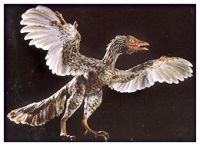 The earliest flying dinosaurs glided between the trees much like the biplanes of early aviation, a team of US and Canadian researchers said in their study published Tuesday in the U.S. journal, Proceedings of the National Academy of Sciences. After re-examining the fossil remains of Microraptor gui, one of the earliest gliders which lived 125 million years ago in the early Cretaceous period in northeastern China, researchers Sankar Chatterjee, Ph.D., Horn professor of museum sciences at Texas Tech University, and R. Jack Templin, a retired aeronautical engineer from Ottawa, Ontario, found that the creatures used two sets of long, asymmetric flight feathers, one on its hands and the other on legs, for flying, similar to a biplane. Contrary to an initial assessment of the fossils, done by Xing Xu of the Chinese Academy of Sciences in 2003, that the dinosaur spread its legs out laterally and maintained its wings in a tandem pattern, like a dragonfly, Chatterjee and Templin have come up with a new idea, saying that the creature dropped its hind legs below its body, adopting a biplane-like posture. The fresh analysis of Microraptor’s limb joints and the direction of the feathers revealed that a dragonfly like tandem wing design would neither have made it possible for the 1kg, 16-inch-long creature to either achieve enough lift nor a capability to walk normally on the ground, meaning that Microraptor was not capable of taking off from the ground and that it was only a moderate glider. During the flight the creature’s posture could have created two staggered wing sections, the upper one slightly ahead of the lower one, Chatterjee's research suggested. Funded by Texas Tech University, the study also calculated that Microraptor could have traveled more than 40 metres with a small jump from a tall tree. It would have fallen quickly to begin with, but then could have swooped back up to land on the branch of another tree. "Aircraft designers have mimicked many of nature's flight inventions, usually inadvertently," wrote Professor Chatterjee. "Now it seems likely that Microraptor invented the biplane 125m years before the Wright 1903 Flyer." The fossils of Microraptor gui were discovered among hundreds of small, well preserved feathered theropods from the Early Crestaceous Jehol Group of northeastern China. The dinosaur is part of a family that preceded the first known bird, Archaeopteryx, which could be described as a monoplane design. Besides Pedopenna, one more flying dinosaur that also had feathers on its legs, modern raptors such as falcons have short feathers on their upper legs that reduce air resistance as they fly, Chatterjee said. Xu, who was not associated with Chatterjee's research team, although called the latest study “likely” but at the same time he said that "we really need to work painstakingly to check all details and have an accurate reconstruction, and then we can compare different models in computer or even in wind tunnel, which we are planning to do.'' "Microraptor is a critical species in understanding the origin of flight," added Xu. |
|
||||||
Disclaimer: The views and investment tips expressed by investment experts on themoneytimes.com are their own, and not that of the website or its management. TheMoneyTimes advises users to check with certified experts before taking any investment decision. ©2004-2007 All Rights Reserved unless mentioned otherwise. [Submit News/Press Release][Terms of Service] [Privacy Policy] [About us] [Contact us] |